10 Best Capture Cards in 2026
Disclosure: As an Amazon Associate we earn from qualifying purchases.
Elgato is the pick for creators who want high-frame-rate capture, VRR passthrough, and wide app support across consoles and computers.
Choosing capture cards gets tricky when you want smooth gameplay, clear recording, and simple setup without paying for features you will not use. The right model depends on your source devices, passthrough needs, and how much latency you can tolerate.
These picks range from basic plug-and-play options to more advanced cards with higher-resolution capture, microphone inputs, or wider display support. Some suit console streaming, while others fit desktop setups, meetings, or portable use.
Top Picks
Top 10 Capture Cards Review
Pros and cons are taken from each product's listing details.
Elgato 4K X Capture Card

- 4K144 capture
- VRR passthrough
- HDR10 support
- USB 3.2 Gen 2
Elgato is a compact option for people who want high-frame-rate capture with broad device support. The listing describes 4K144 capture, VRR passthrough, HDR10, and up to 1080p240 capture through HDMI 2.1, plus USB 3.2 Gen 2 for low latency. It also states support for OBS and more, along with PS5, Xbox, Switch, PC, and Mac.
This pick suits streamers who want a modern capture card that can handle fast gameplay and still fit into a flexible software setup. Its small 2.1 in size may appeal if you want a simpler desk footprint, and the listed platform range makes it easier to use across different systems without narrowing your setup too much.
Guermok Video Capture Card

- 4K USB 3.0 capture
- Plug and play
- Wide software support
- Portable build
- Capture use only
- One-way transmission (HDMI to USB-C)
Guermok focuses on simple setup and wide compatibility. It uses aluminum, connects through USB 3.0, and lists up to 4K@30Hz input with output up to 2K@30Hz or 1920×1080@60Hz. The listing also describes plug-and-play use, no external power, and support for streaming tools and systems including OBS, Windows, Mac, Linux, Android, and several consoles.
This one suits users who want a small adapter-style card for recording, live meetings, or gaming without extra drivers. The one-way HDMI to USB-C design and capture-only note are important limits, so it makes the most sense when you know you need straightforward input to recording software, not direct screen casting.
acer USB 3.0 HDMI Capture Card

- Mic-in port
- YUY2 color support
- Low-latency capture
- Easy plug and play
Acer is built for users who want commentary alongside capture. The listing says it supports 4K input and 1080P@60Hz output, uses YUY2 technology, and includes a mic-in for easy voice recording. It also describes plug-and-play setup with no extra drivers or external power, plus compatibility with OBS and a long list of devices and apps.
This pick works well for gamers, teachers, and creators who want audio and video on one device without adding adapters. The 3.5 mm mic support makes it especially useful if you plan to speak while recording or streaming, and the lightweight design should suit people who move between rooms or setups often.
Dcyfol Capture Card 4K HDMI Video Streaming to USB 3.0 1080P 60FPS Capture
- 4K HDMI capture
- 1080P 60FPS output
- Plug-and-play setup
- No drivers needed
- Compact and portable
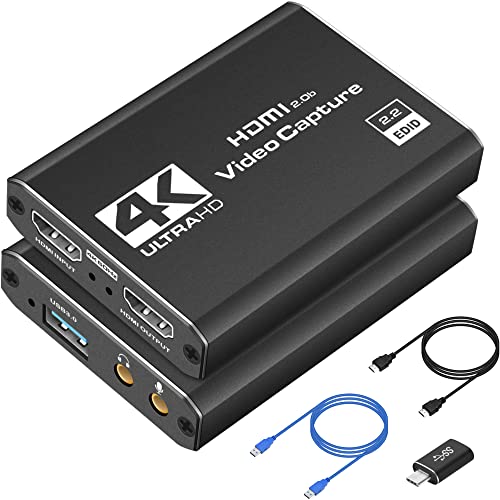
Dcyfol is aimed at creators who want a simple USB capture device for streaming or recording. It describes 4K HDMI capture with 1080P 60FPS video quality, plug-and-play use with no drivers, and compatibility with OBS Studio, Streamlabs, and XSplit. The listing also says it supports passthrough for play without lag and has a compact, portable build.
This model suits someone who wants an uncomplicated recorder for home, studio, or travel use. Because the listing keeps the feature set focused, it makes more sense for users who value a setup than for people who need advanced display features or more detailed technical options.
UGREEN 4K@30Hz Loop Out HDMI Capture Card for 2K 30FPS 1080P 60FPS USB 3.0

- 2K@30Hz capture
- 4K input and loop-out
- Dual USB interface
- Plug and play
- 4K capture is not supported
UGREEN centers on 2K capture with flexible connections. The listing supports up to 2K 30fps, 4K@30Hz input, and 4K@30Hz loop-out, and it includes USB-A and USB-C interfaces. It also describes plug-and-play use, a sturdy aluminum casing, and compatibility with Windows, macOS, Linux, Android, Switch, Switch 2, PS4, PS5, Xbox Series X, and Meta Quest.
This is a good fit if you want a durable capture card for mixed devices and local preview. The note that 4K capture is not supported matters if you need higher recording resolution, and the iPhone limitation means it is better suited to the listed computers, consoles, and supported handheld or headset sources.
VIXLW Video Capture Card

- 2K recording
- Ultra-low latency
- Compact build
- Type-C support
VIXLW is another aluminum capture card designed for easy setup and broad device support. It handles up to 4K@30Hz HDMI input and records at 2K@30Hz or 1080P@60Hz. It also describes ultra-low latency transmission, dual-channel audio, plug-and-play use, and compatibility with Windows, macOS, Linux, Android, OBS, Zoom, VLC, Twitch Studio, and more.
This pick suits users who want a compact card for streaming, meetings, or game recording across several platforms. The USB 3.0 and Type-C connection options make it handy for mixed hardware, and the listed support for many systems and devices gives it a flexible role in a simple desktop setup.
NEWCARE HDMI Video Capture Card for Streaming

- 4K60 HDR passthrough
- 1440p144 support
- Mic input
- USB-A/USB-C 2-in-1
NEWCARE is designed for people who want strong passthrough options with a compact body. The listing includes up to 4K@60Hz HDR input and pass-through, 1080P@60FPS capture, 1440p144 support, and a 2 in aluminum housing. It also mentions USB 3.0 and Type-C 2-in-1 connections, a 3.5 mm mic input, and headphone monitoring.
This card suits gamers who want to keep playback smooth on a display while recording at a lower resolution. The included mic and headphone connections add convenience for live commentary, and the listed compatibility with Windows, macOS, PS5, PS4, Xbox, Switch, DSLR cameras, and camcorders makes it useful across several setups.
AVerMedia Live Gamer ULTRA S 4K60 HDMI Capture Card with RGB24

- 4K60 capture
- 1440p144 support
- 5.1 audio
- IPad support
AVerMedia is aimed at users who want advanced capture options and broad display support. The listing describes 4K60 capture, RGB24 full-color on Windows, 1440p144 and 1080p240 capture, HDR and VRR passthrough, and support for ultrawide input. It also notes 5.1 audio on Windows and compatibility with Windows, macOS, and iPadOS.
This pick suits more demanding gaming setups where display modes and audio format matter. It stands out if you want support for PS5, Xbox, Switch 2, or PC alongside 21:9 input, and the listed software workflow may appeal if you want a more advanced path into recording and streaming on a desktop system.
Generic 4K Capture Card Game Capture Card 1080P 60FPS for Streaming

- 1080p60 capture
- Mic input
- Headphone output
- One-year warranty
- Maximum output is 1080P60Hz only
Generic is a basic capture card with a strong focus on simple recording and commentary. It supports up to 4K30Hz input and 1080p60fps capture, includes 3.5 mm microphone input and headphone output, and works with several devices and operating systems. It also describes plug-and-play recognition without drivers or external power.
This option suits people who want a card for live streaming, game recording, or meetings without extra setup steps. The 3.5 mm ports make it useful for voice work, and the output cap at 1080P60Hz only is the main limit if you want more from your display chain.
PDAPTMAG 4K Video Capture Card

- 1080p capture
- Plug and play
- Compact size
- USB 2.0 connection
- 1080P 30FPS full HD recording
PDAPTMAG is the simplest entry in this group. It describes 1080p capture, USB 2.0 operation, plug-and-play setup, and compatibility with Windows, macOS, and Linux. The listing also mentions HDMI audio and video input, compact portability, and use for streaming, recording, gaming, and screen sharing in meetings.
This pick suits basic setups where ease of use matters more than advanced capture features. The USB 2.0 connection and 1080P 30FPS full HD recording limit it compared with more capable cards, so it makes the most sense for casual streaming or simple presentation sharing.
How to Choose Capture Cards
Match Input And Output
Start with the video source and the display you want to keep using while recording. Some cards focus on higher input support, while others prioritize smoother local passthrough or lower capture output.
It also helps to think about the resolution you actually need for recording. A card that handles a higher input signal is not always the same as one that records at that same level.
Check Connection Type
Connection type affects setup speed, latency, and which devices can work cleanly together. USB-A, USB-C, and dual-interface designs each make sense in different systems, and some cards need a specific port standard to reach their listed performance. A good match can reduce adapter clutter and keep the signal path stable.
Look at whether the card needs external power, a driver install, or a direct link to the computer rather than a hub. Those details change how easy it is to start streaming or recording.
Think About Audio Needs
Audio support can be just as important as picture quality. Some cards include a mic input for commentary, while others add headphone output for monitoring. If you plan to speak while playing or recording, those ports can save you from extra accessories and make the whole setup more organized.
Pay attention to how the audio ports are described and whether the card keeps voice and gameplay in sync. That matters for streams, tutorials, and meeting use. A cleaner audio path can also make editing easier later because you will not have to manage separate recording gear as often.
More to Consider for Capture Cards
Software Support
Check which recording apps and streaming platforms the card names directly. Compatibility with OBS, Streamlabs, VLC, Zoom, or similar tools can make setup smoother and reduce surprises later. If you already use a specific app, matching that workflow matters more than chasing extra features you may never use.
Build and Cooling
A metal housing can help some cards feel sturdier and may improve heat dissipation during longer sessions. That does not replace good airflow, but it can be worth noticing if you plan to stream for hours at a time or move the device often between rooms or setups.
Portable Use
If you plan to travel, size and power requirements become more important. Smaller cards are easier to pack, and models that do not need external power can be simpler to use in temporary setups. Portability is especially useful when you want a setup that moves easily between a desk, event space, or meeting room.
Frequently Asked Questions
What should I look for first in a capture card?
Start with the signal path you need. The most important details are the supported input resolution, the capture resolution, and whether the card offers passthrough for the screen or monitor you already use. It also helps to check the connection type and whether the device works with your editing or streaming app, since those two things shape how easy the setup feels.
How important is a microphone input?
It matters most if you plan to add live commentary without a separate audio interface. Acer, NEWCARE, and Generic each list a 3.5 mm microphone input, while NEWCARE and Generic also mention headphone output for monitoring. If you only need clean video capture, that port may not be necessary, but it becomes useful for streaming, classes, and voice recording.
Which pick is strongest for high-frame-rate gaming?
Elgato and AVerMedia are the most suited to faster gameplay. Elgato lists up to 4K144 capture and up to 1080p240 capture, while AVerMedia lists 4K60 capture, 1440p144, and 1080p240 capture with HDR and VRR passthrough. NEWCARE also supports 1440p144 passthrough, but its capture spec is lower than those two.
Which option is easiest for a simple setup?
Guermok, Acer, Dcyfol, and PDAPTMAG all describe plug-and-play use with no driver or external power needs, which keeps setup simple.
Which card is better for consoles and desktop devices together?
Elgato lists PS5, Xbox, Switch, PC, and Mac support, so it covers both console and computer use well.
Final Verdict
Elgato stands out for high-frame-rate capture, VRR passthrough, HDR10 support, and USB 3.2 Gen 2 connectivity. The listing also covers broad app support and compatibility with PS5, Xbox, Switch, PC, and Mac, which makes it a strong fit for people who want one card for many modern devices.
Guermok suits buyers who want an aluminum, plug-and-play option with capture-only HDMI to USB-C use. Acer is a good match if you want a mic-in port for commentary.